
Why Better Financial Workflows Create Better Law Firm Bookkeeping

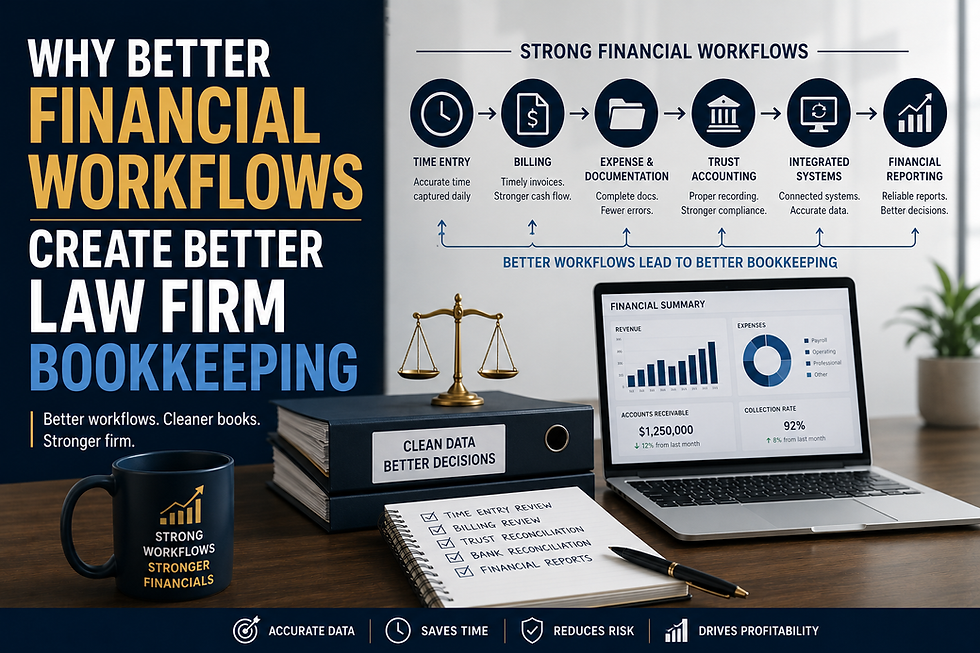
Ask most managing partners what makes bookkeeping accurate, and they'll point to the bookkeeper. Better software, more experience, tighter oversight. What they rarely point to is the thing that actually determines accuracy: the workflow that produces the numbers before a bookkeeper ever touches them.
Clean books aren't a bookkeeping outcome. They're a workflow outcome. Every figure in your financial statements started as a decision someone made upstream: how they entered time, whether they kept a receipt, when they recorded a trust deposit. Law firms that standardize those decisions spend far less time correcting errors and far more time using their numbers to actually run the business. This article looks at the specific workflows that separate firms with reliable financials from firms that are perpetually cleaning up.
Bookkeeping Is the Final Step, Not the First
Every dollar that lands in your accounting system has a history. It started as a time entry, a client invoice, a trust deposit, an expense approval, or a vendor payment. By the time it reaches the books, it has already passed through several hands and several decisions, and none of those decisions were made by your bookkeeper.
Financial reporting is only as reliable as the workflows that generate the data feeding it.
This is the piece most firms miss. When the inputs are inconsistent, one attorney enters time daily, another enters it in bulk once a month; one expense gets documented, another gets remembered, and the bookkeeping reflects that inconsistency, no matter how skilled the person recording it is. Better inputs, not better bookkeepers, are what produce better financial data.
Workflow #1: Consistent Timekeeping and Billing
Timekeeping isn't an administrative task; it's the foundation of revenue recognition. If time isn't entered accurately and promptly, the firm doesn't actually know what it has earned, only what it has invoiced, and those two numbers can diverge significantly.
An effective billing workflow has a few defining characteristics: time entered daily rather than reconstructed from memory, a billing schedule that runs on a fixed cadence rather than "whenever someone gets to it," invoice reviews that happen before bills go out rather than after clients complain, and write-off policies applied consistently instead of case-by-case.
When this workflow is solid, the effect on bookkeeping is direct. Revenue reporting becomes more accurate because it reflects work actually performed, reconciliation gets easier because WIP and billed amounts stay aligned, and receivables issues shrink because invoices go out consistently instead of in unpredictable batches.
Workflow #2: Organized Documentation and Expense Management
Every financial document, a client expense, a vendor invoice, a receipt, a credit card charge, should move through the firm in the same predictable way, regardless of who generated it or which office they're in. When documentation has no standard path, it either gets lost, gets recorded late, or gets recorded incorrectly, and the bookkeeper ends up chasing down details weeks after the fact.
A standardized documentation process pays off in ways that go beyond convenience: bookkeeping moves faster because information arrives complete the first time, fewer adjustments are needed after the fact, the firm is meaningfully more audit-ready, and reporting accuracy improves because nothing is missing or estimated.
Workflow #3: Reliable Trust Accounting Procedures
Trust accounting carries a different level of consequence than the rest of your books, which is why it deserves its own standard of consistency rather than being treated like just another category of transaction.
A reliable trust workflow records deposits promptly instead of in batches, tracks client costs accurately as they occur, performs three-way reconciliations on a regular schedule rather than only when something looks off, and clearly assigns responsibility so no step depends on memory or informal habit.
The payoff here isn't just cleaner numbers; it's real risk reduction. Firms with disciplined trust workflows have stronger compliance postures, cleaner financial records overall, and far more confidence when they need to state a trust balance with certainty.
Workflow #4: Connected Financial Systems
Most firms run several systems that each hold a piece of the financial picture, practice management, billing, payroll, and accounting. When those systems don't talk to each other, someone has to manually bridge the gap, and manual bridges are where accuracy breaks down.
A firm's financial systems should tell the same story without anyone having to translate between them.
Integration, where it's practical, produces four concrete benefits: less manual data entry, fewer duplicate records competing for accuracy, faster reporting because data doesn't have to be reconciled across platforms first, and improved accuracy overall because the same information isn't being typed in multiple times by multiple people.
Workflow #5: Standardized Month-End Closing
Month-end close is where inconsistent workflows become visible; if the process isn't repeatable, the close takes longer every single month, and the results are harder to trust. Every firm should be able to run through the same sequence in the same order: bank reconciliations, trust reconciliations, an accounts receivable review, an accounts payable review, and financial statement preparation.
Standardizing this sequence isn't just about speed, though faster close cycles are a real benefit. It also produces more reliable reports, since the same checks happen every time instead of depending on who's doing the close that month, and it makes performance analysis genuinely useful because you're comparing numbers built the same way, month over month.
Workflow #6: Automation for Routine Financial Tasks
Not every task needs a person doing it manually every time. Bank feeds, invoice reminders, expense capture, recurring journal entries, and routine approval workflows are all strong candidates for automation; they're repetitive, rules-based, and prone to small human errors that compound over time.
The value of automation here isn't primarily about saving time, though it does. It's about accuracy. Every manual step is a place where a number can be mistyped, a transaction can be missed, or a deadline can slip. Removing the manual step removes the opportunity for that error to happen in the first place.
The Business Benefits of Better Financial Workflows
The impact of strong financial workflows extends well past the bookkeeping itself. Firms that get this right see cleaner financial records that require less correction, better visibility into cash flow because revenue and expenses are recorded when they actually happen rather than weeks later, faster financial reporting that supports real-time decisions instead of retrospective ones, more reliable performance metrics that partners can actually act on, meaningfully improved decision-making at the leadership level, and lower administrative costs because staff spend less time fixing problems and more time doing productive work.
Questions Every Law Firm Should Ask About Its Financial Workflows
A short, honest self-assessment tends to reveal more than a full financial review. Are invoices issued on time every billing cycle, without exception? Is every expense backed by documentation, or are some simply estimated? Can the firm complete month-end close consistently, on a predictable timeline? Are trust accounts reconciled on schedule, every time, by design rather than by reminder? How many spreadsheets exist outside the core accounting system just to "keep track" of something the system should be tracking on its own? And where, specifically, do delays tend to occur in financial operations: is it billing, documentation, trust processing, or the close itself?
The answers to these questions usually point directly to which workflow needs attention first.
Building Financial Workflows That Scale
Firms that sustain clean bookkeeping as they grow tend to approach it the same way: they standardize financial policies so processes don't vary by person or office, document core processes so institutional knowledge isn't trapped in one person's head, train staff consistently so everyone follows the same procedure the same way, integrate technology thoughtfully rather than adding tools that create more silos, and review and improve workflows as the firm grows rather than assuming what worked at ten attorneys will still work at fifty.
Scalable financial operations aren't the result of a single overhaul. They're the result of continuous refinement, treating workflows as something to actively manage, not something you set up once and leave alone.
Conclusion
Strong bookkeeping is not something you achieve by hiring the right bookkeeper. It's something you build by designing the workflows that feed your books, consistent timekeeping, organized documentation, disciplined trust procedures, connected systems, a standardized close, and automation where it makes sense. Get those right, and clean books become the natural byproduct rather than a monthly project.
The real shift for growing firms is this: better workflows don't just produce cleaner books, they produce a more efficient, more resilient, and more profitable firm. If you're not sure where your financial workflows are creating friction, that's the conversation worth having next, and it's exactly the kind of conversation Self Made CFO exists to have.


Comments