
Clio vs Filevine for Litigation-Focused Law Firms: Which Platform Is the Better Fit

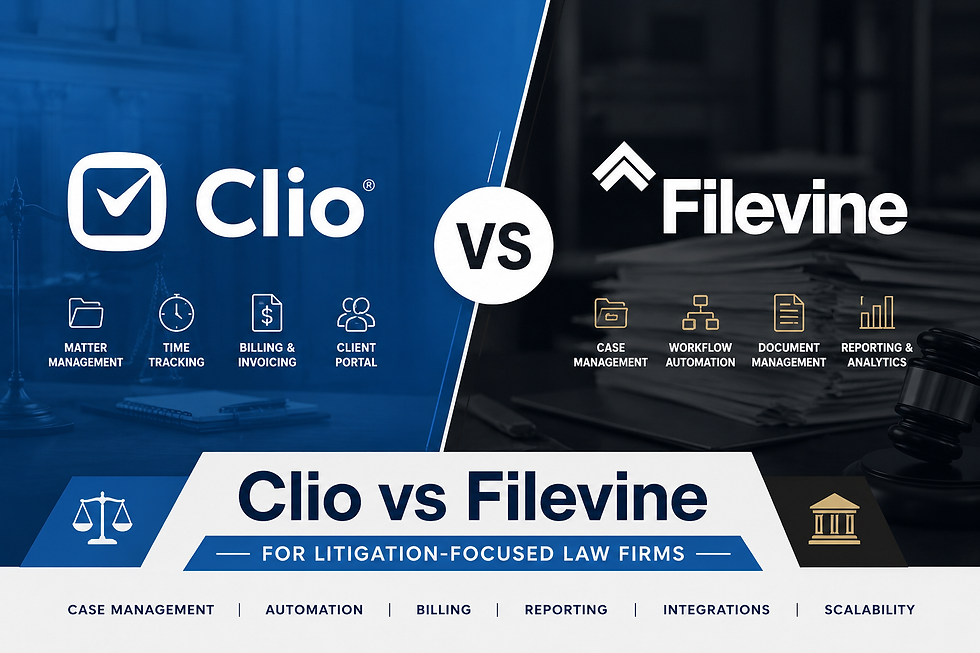
The most common mistake litigation firms make when selecting practice management software is evaluating platforms designed for general legal practice as if they were built for litigation. They're not, and the difference matters more than most firms realize until they're already embedded in a system that can't support how they actually work.
Litigation is operationally distinct. Case timelines are long and unpredictable. Document volumes are high. Workflows involve multiple parties, court deadlines, discovery management, and status tracking across dozens or hundreds of active matters simultaneously. A platform that handles billing and client communication well for a transactional practice may create significant operational friction in a litigation environment, not because it's a bad platform, but because it wasn't designed for that workload.
Clio and Filevine are two of the most frequently compared platforms in this decision. They share surface-level similarities, cloud-based case management, document storage, billing, and reporting, but they were built with fundamentally different operational profiles in mind. Understanding that difference is what makes this comparison useful.
Clio Overview
What Is Clio?
Clio is the most widely adopted cloud-based practice management platform in the legal market, built to serve a broad range of practice types and firm sizes. Its strength is breadth, a comprehensive feature set, an extensive integration ecosystem, and a user experience designed for accessibility across different practice areas and levels of technical sophistication.
Core Features
Clio's core capabilities cover matter management, document storage and management, time tracking, billing and invoicing, and client portal access. These features are well-developed and handle the standard operational requirements of most legal practices competently.
Strengths for Litigation Firms
Clio's primary advantage for litigation firms is its accessibility and integration ecosystem. The platform is easy to adopt, and attorneys and staff can be operational quickly without significant training investment. Its integrations with QuickBooks, Xero, LawPay, NetDocuments, Microsoft 365, and dozens of other tools allow firms to build connected workflows across their technology stack. For litigation firms that also handle transactional or advisory work, Clio's flexibility across practice areas is a genuine advantage, one platform that serves multiple functions without requiring separate systems.
Potential Limitations
Clio was not built for litigation specifically, and that shows in the areas where litigation firms need the most operational support. Workflow customization for complex case pipelines is more limited than what Filevine offers. Advanced automation, the kind that manages multi-stage litigation workflows, flags deadline dependencies, and tracks case status across high-volume dockets, requires additional tools and integrations that add cost and configuration complexity. For firms where litigation workflow management is the central operational challenge, Clio addresses it adequately but not optimally.
Best Fit
Clio is ideal for solo litigators and small litigation firms where simplicity and fast implementation matter more than deep workflow customization. It also works well for general practice firms where litigation is one of several practice areas, and the need for a platform that handles everything competently outweighs the need for litigation-specific depth.
Filevine Overview
What Is Filevine?
Filevine is a case management platform built specifically for litigation and high-volume legal practice. Where Clio was designed to serve the broadest possible range of legal work, Filevine was designed to solve a specific operational problem: managing complex, high-volume litigation workflows with the visibility, automation, and customization that general practice platforms don't provide.
Core Features
Filevine's core capabilities include case management with highly customizable matter pipelines, advanced workflow automation, document management, reporting and analytics, and collaboration tools built around the demands of active litigation. The platform is organized around the concept of project-based case management; every matter has a defined structure, status tracking, and workflow logic that reflects how litigation actually progresses.
Strengths for Litigation Firms
Filevine's litigation-specific design is its clearest advantage. Matter pipelines can be customized to match the firm's actual workflow, from intake through discovery, motions practice, trial preparation, and resolution, with automated task assignments, deadline triggers, and status visibility at every stage. For personal injury firms, mass tort practices, and any litigation shop managing a high volume of active matters, visibility and automation are not a convenience. It's an operational requirement.
Advanced reporting and analytics give firm leadership meaningful data on case status, staff workload, matter aging, and operational bottlenecks, the kind of management information that is difficult to extract from a general practice platform not designed to surface it.
Potential Limitations
Filevine's depth comes with a steeper learning curve and a more complex implementation process than Clio. Configuring the platform correctly for a specific firm's workflows takes time and expertise; done carelessly, the customization capability becomes a liability rather than an asset. For smaller firms or practices with straightforward litigation workflows, Filevine's complexity can feel disproportionate to what they actually need. The platform is built for scale; it performs best when that scale exists or is the clear direction of growth.
Best Fit
Filevine is the right fit for personal injury firms, litigation-heavy practices managing high case volumes, mid-size and larger litigation shops, and any firm where workflow automation and case visibility are operational priorities rather than nice-to-haves.
Head-to-Head Comparison
Category | Clio | Filevine | Edge |
Ease of Use | Intuitive; fast adoption | Steeper curve; more setup | Clio |
Litigation Workflow Management | Adequate; less customizable | Deep; litigation-native | Filevine |
Automation | Integration-driven | Built-in; highly configurable | Filevine |
Document Management | Strong; broad integrations | Strong; litigation-optimized | Tie |
Reporting & Analytics | Good; general purpose | Strong; litigation-specific | Filevine |
Financial Management & Billing | Flexible; well-developed | Functional; less billing depth | Clio |
Integrations | Extensive ecosystem | Solid; narrower range | Clio |
Scalability | Strong across firm sizes | Built for volume and growth | Filevine |
Which Platform Is Best for Different Types of Litigation Firms?
Solo Litigator
A solo litigator managing a moderate caseload with relatively straightforward workflows doesn't need Filevine's depth, and shouldn't pay for it. Clio handles matter management, billing, and client communication efficiently, with an implementation that doesn't require significant time investment to configure correctly. The integration ecosystem covers the tools a solo practitioner is likely to use. Filevine's complexity and cost structure are built for higher-volume environments.
Small Litigation Firm
For a firm of two to five attorneys managing a manageable docket, Clio's usability and lower implementation overhead are advantages. If the firm's practice is concentrated in personal injury or another high-volume litigation area where case pipeline visibility is a daily management requirement, Filevine becomes worth evaluating, but only if the firm has the capacity to configure and maintain it properly.
Personal Injury Firm
Personal injury practices are the use case Filevine was most clearly built for. High case volume, intake-to-resolution workflows, settlement tracking, and the need to monitor dozens of active matters simultaneously are all areas where Filevine's litigation-native design creates genuine operational advantages. Clio can manage personal injury work, but it requires more manual oversight and integration workarounds to achieve the same visibility that Filevine provides natively.
High-Volume Litigation Practice
When case volume reaches the point where matter status, deadline management, and staff workload require systematic operational infrastructure rather than individual tracking, Filevine's automation and reporting capabilities become essential rather than optional. Managing a high-volume docket on a general practice platform creates operational friction that quietly erodes productivity and increases the risk of errors.
Multi-Office Litigation Firm
Multi-office practices need consistent workflow standards, centralized case visibility, and reporting that gives leadership a real-time picture of operational performance across locations. Filevine's customization and reporting depth support that management requirement. Clio can serve multi-office firms, but the reporting and workflow standardization capabilities at that scale favor Filevine.
Choose Based on How Your Firm Actually Operates
Choose Clio If...
Your firm values simplicity and fast implementation over deep workflow customization. Your litigation practice is one of several practice areas, and you need a platform that handles all of them competently without separate systems. Your caseload is manageable without advanced automation, and the priority is a well-integrated, easy-to-maintain operational platform. You're a solo practitioner or small firm where Filevine's complexity and cost structure would be disproportionate to your actual needs.
Clio is the right choice when operational breadth matters more than litigation depth, and when the firm's growth trajectory doesn't require the advanced workflow infrastructure Filevine provides.
Choose Filevine If...
Litigation is the firm's primary or exclusive focus. Your practice manages high case volume where matter pipeline visibility, automated deadline tracking, and staff workload management are daily operational requirements. You're running a personal injury, mass tort, or similarly structured practice where intake-to-resolution workflow management is central to how the firm operates. You have the implementation capacity to configure the platform correctly and the case volume to justify the investment.
Filevine is the right choice when litigation workflow management is the central operational challenge, and when the firm needs infrastructure built specifically to solve it, not a general platform adapted to approximate it.
The Right Platform Is the One That Matches How You Work
Practice management software is an operational infrastructure. Choosing it based on name recognition, pricing, or a colleague's recommendation, without analyzing how the firm actually manages its caseload, is how firms end up with platforms that create friction instead of removing it.
For litigation firms specifically, the gap between a general practice platform and a litigation-native one is real and consequential. It shows up in how cases are tracked, how deadlines are managed, how staff workload is distributed, and how firm leadership understands operational performance. Those aren't abstract differences; they affect revenue, efficiency, and the firm's capacity to grow without proportionally increasing overhead.
Clio and Filevine are both capable platforms. The question is not which one is better in the abstract. It's which one fits the operational profile of your specific firm, and which one will still fit as your caseload grows.
About The Author
Ashley Bennett is an accountant at Self-Made CFO with three years of exclusive experience serving law firms. Her background in legal accounting has given her a sophisticated understanding of the financial structure, reporting expectations, and operational nuances unique to legal practices.


Comments